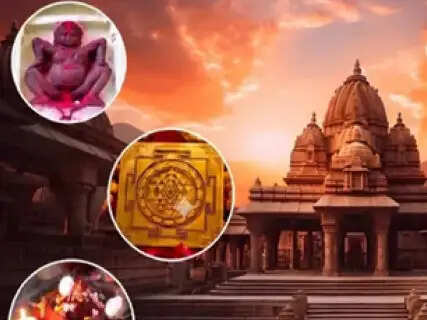
India’s vast spiritual landscape is home to thousands of ancient shrines, each holding a unique position in global heritage. While mainstream Hinduism typically centers around the intricate worship of sculpted idols (Murti Pooja), there exists a highly enigmatic cluster of pilgrimage sites that completely break away from this tradition. Scattered across the diverse geography of the Indian subcontinent, these seven mysterious temples do not house any artificial statues in their inner sanctum sanctorum (Garbhagriha). Instead, millions of global travelers and local devotees offer their prayers to rare, naturally occurring phenomena, sacred geometry, and unexplainable elemental wonders.1. Jwala Devi Temple (Himachal Pradesh): The Eternal Volcanic FlamesNestled in the picturesque Kangra district of Himachal Pradesh, the historic Jwala Devi Temple stands as an incredible manifestation of natural energy. In this sacred complex, there are absolutely no traditional stone or metal sculptures of any deity. Instead, devotees direct their prayers toward nine natural, blue flames that have been burning continuously out of solid rock crevices since time immemorial. Despite numerous scientific expeditions and historical attempts by past rulers to extinguish them, the flames continue to blaze naturally without the use of artificial fuel, oil, or ghee, revered by pilgrims as the absolute living forms of Goddess Durga.2. Kamakhya Devi Temple (Assam): The Sacred Rock of the WombPerched atop the Nilachal Hills in Guwahati, Assam, the Kamakhya Temple is globally recognized as the pinnacle of Tantric architecture and one of the most powerful of the 52 Shakti Peethas. Inside the cave-like inner chamber, visitors will find no statue of a goddess. The focal point of deep devotion is a natural, subterranean rock fissure shaped like a female womb (Yoni). The sacred rock is perpetually kept moist by a natural underground spring. Once a year, during the famous Ambubachi Mela, the spring water naturally turns red, signifying the earth's fertility cycle, attracting spiritual seekers from all corners of the world.3. Kodungallur Bhagavathy Temple (Kerala): The Mystical Covered PondLocated in the historic Thrissur district of Kerala, the ancient Kodungallur Bhagavathy Temple preserves a unique ritualistic setup that continues to fascinate modern historians. While the temple complex is vast, a highly restricted, secret zone within the inner sanctum features a mysterious natural pond instead of a conventional deity structure. Considered highly sacred by the local ecosystem, this pond is kept under a permanent protective cover. The hidden water source is worshipped as the source of primal energy, allowing the community to connect directly with the formless divine through elemental water.4. Amarnath Cave Temple (Jammu & Kashmir): The Sovereign Ice LingamHigh up in the snow-capped Himalayan ranges of Jammu and Kashmir, the Amarnath Cave Temple stands as one of the ultimate seasonal pilgrimage destinations on earth. Inside the massive natural limestone cave, there are no permanent man-made idols. Every summer, a magnificent Shivalinga naturally forms out of freezing water droplets dropping from the cave roof, growing and shrinking dynamically in sync with the phases of the moon. Affectionately called Baba Barfani by millions of traveling pilgrims, this temporary ice stalagmite is worshipped as the absolute natural form of Lord Shiva.5. Ambaji Temple (Gujarat): The Geometry of the Holy YantraThe globally renowned Ambaji Temple, situated in the Banaskantha district of Gujarat near the Rajasthan border, represents a highly sophisticated form of abstract Vedic worship. Visited by thousands of domestic and international travelers daily, the temple completely lacks an idol of the presiding deity. Instead, the focus of all daily rituals and decorations is the highly sacred "Shri Visa Yantra"—a precise piece of sacred geometry engraved onto a golden plate. The geometric configuration is so carefully guarded that even priests perform the rituals blindfolded, while devotees experience the deep presence of the goddess through pure geometric meditation.6. Kalimath Temple (Uttarakhand): The Void of Cosmic DisappearanceTucked away in the high-altitude Rudraprayag district of Uttarakhand along the banks of the Saraswati River, the Kalimath Temple is wrapped in profound mystical lore. Celebrated as a major Shakti Peetha, this Himalayan shrine contains no physical statue of Goddess Kali. The focal point of the temple is a deep, silver-plated pit in the ground, marking the precise geographical spot where ancient mythology states the goddess disappeared into the subterranean layers of the earth after vanquishing the demon Raktabeedj. Prayers are offered to this sacred void and an associated Sri Yantra, symbolizing the formless cosmic energy.7. Achleshwar Mahadev Temple (Rajasthan): The Sacred Toe Print of Mount AbuSituated near the historic ruins of Achalgarh fort in the scenic hills of Mount Abu, Rajasthan, the Achaleshwar Mahadev Temple offers a striking variation of Shaivite worship. Visitors entering the ancient structure will look in vain for a standard stone Shivalinga or a sculpted statue of Mahadev. Instead, the central focus of the temple's sanctum is a natural, deep pit in the floor. This geological depression is firmly believed to be the permanent imprint of Lord Shiva’s right great toe, which he placed down to stabilize the shifting Arvali mountain range. Devotees offer water, milk, and prayers directly into this natural footprint to seek spiritual stability.