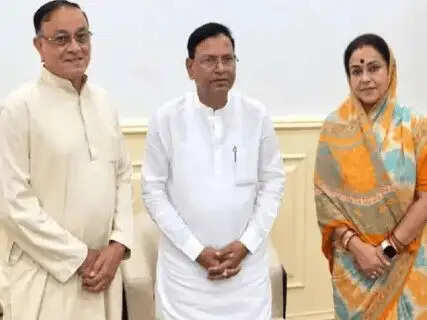
Administrative convenience and geographic accessibility have taken center stage in regional politics as prominent Bharatiya Janata Party (BJP) leader and former minister Dr. Ameeta Singh voiced her strong support for local administrative restructuring. Dr. Singh has formally backed the persistent demand put forward by residents of 18 Gram Sabhas within the Trisundi and Peeparpur Nyay Panchayats of the Bhadar region, who are advocating to be detached from Amethi district and re-integrated into neighboring Sultanpur.The movement, which addresses long-standing logistical hurdles faced by rural populations, gained momentum after a dedicated public delegation met with the BJP leader at her office in Ramganj, submitting a comprehensive memorandum detailing their daily grievances.The Core Grievance: Excessive Distance to Amethi HeadquartersThe primary catalyst behind the demand for boundary reorganization stems from severe logistical friction and commuting hardships faced by villagers. According to the memorandum presented by the local delegation—led by prominent community representative Prem Narayan Pandey—rural residents currently find themselves severely disadvantaged by district administrative boundaries.The distance from these 18 Gram Sabhas to the current Amethi district headquarters in Gauriganj ranges between a grueling 45 to 65 kilometers. In stark contrast, traveling to the Sultanpur district headquarters covers a mere 10 to 20 kilometers. For ordinary villagers, farmers, and daily wage earners needing to access government offices, revenue courts, police stations, and welfare scheme documentation, navigating the massive distance to Gauriganj translates into immense physical exhaustion, prohibitive transportation costs, and lost workdays."The distance to the headquarters is creating continuous roadblocks for citizens trying to access basic governance," representatives noted, pointing out that inadequate public transport connectivity compounds the financial and temporal burden on local households.Dr. Ameeta Singh Assures Full Support and Government OutreachRecognizing the genuine merit of the public grievance, Dr. Ameeta Singh interacted at length with the visiting delegation, patiently listening to their administrative challenges. She acknowledged that administrative boundaries are ultimately designed to serve the populace, and when structural distances obstruct smooth governance, reforms deserve serious legislative consideration.Dr. Singh assured the residents that she would take personal cognizance of the matter, promising to formally convey the public memorandum and their urgent plea directly to Chief Minister Yogi Adityanath and relevant state revenue ministry officials. Her endorsement has significantly amplified the visibility of the movement, turning a localized administrative petition into a prominent regional discussion.The Broader Implications of District Boundary Adjustments in Uttar PradeshThe call to merge these specific Gram Sabhas back into Sultanpur touches upon historical administrative transitions. Amethi was officially carved out as a separate administrative district from Sultanpur in 2010, designed to decentralize governance and bring administrative machinery closer to rural pockets. However, in border regions like Bhadar, Trisundi, and Peeparpur, historical ties and geographical proximity to Sultanpur have meant that villagers frequently look toward Sultanpur for commercial, educational, and legal necessities.Local analysts suggest that if the state government reviews the memorandum favorably, it could prompt a technical feasibility study by revenue authorities to evaluate whether modifying the territorial jurisdiction of these 18 Gram Sabhas will streamline public welfare delivery. As the administration weighs the administrative logistics, the residents of Bhadar remain hopeful that a pragmatic boundary adjustment will finally bring governance to their doorsteps.
Around the web