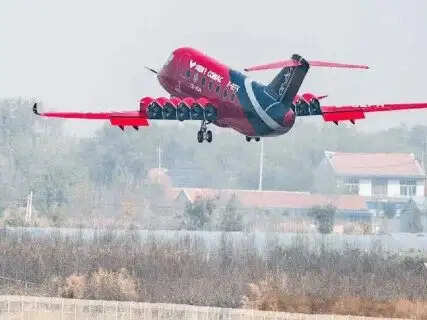
The global aviation landscape is undergoing a quiet yet profound revolution, and clean-energy flight has just hit a major milestone. The Commercial Aircraft Corporation of China (COMAC) has successfully conducted the maiden piloted test flight of its ambitious CE-25A electric aircraft in Binzhou, located in China’s eastern Shandong province.Representing a massive leap forward for sustainable transportation and regional mobility, the 10-metric-ton-class (approximately 22,000-pound) commuter aircraft took to the skies with a crew on board. This successful flight moves China one step closer to practical, battery-powered regional airline travel, signaling a paradigm shift away from traditional fossil-fuel-reliant jet engines.Inside the Historic Flight: Performance and SpecificationsAccording to reports from state broadcaster CCTV and official corporate disclosures, the landmark flight carried a crew consisting of two test pilots and a flight test engineer. During the sortie, the aircraft spent 16 minutes and 38 seconds airborne, covering a distance of 60.4 kilometers (37.5 miles) before executing a smooth landing. The entire testing window, encompassing pre-flight checks and post-landing protocols, lasted 57 minutes and 46 seconds, with all onboard systems operating entirely within normal parameters.The CE-25A is engineered specifically for short-haul intercity routes. Key technical specifications of the 19-seat passenger aircraft include:Passenger Capacity: 19 seats configured for commuter-class travel.Maximum Takeoff Weight: 10 metric tons (approx. 22,000 lbs).Cruising Speed: 300 kilometers per hour (approx. 186 mph).Operating Altitude: A cruising ceiling of 2,400 meters (7,870 feet).Maximum Range: Up to 400 kilometers (250 miles) on a single charge.Innovative Distributed Propulsion and Cross-Industry CollaborationUnlike conventional turboprop or jet aircraft that rely on central combustion engines, the CE-25A utilizes a cutting-edge electric ducted-fan propulsion system. Ten electric ducted fans are distributed evenly across the wings (five on each side), providing redundant thrust, enhanced aerodynamic efficiency, and significantly reduced acoustic signatures compared to traditional aircraft.The development of the CE-25A is a collaborative triumph pooling expertise from across China's high-tech manufacturing sector. COMAC partnered closely with CATL (Contemporary Amperex Technology Co. Ltd.), the world's leading battery manufacturer, alongside academic powerhouses like Shanghai Jiao Tong University. This synergy leverages advanced high-density energy storage solutions necessary to power heavy commercial airframes over viable commercial distances.Clearing Regulatory Hurdles and the Path ForwardThe milestone flight follows months of rigorous uncrewed testing. The aircraft originally completed its first autonomous unmanned flight on February 2, subsequently logging 19 successful uncrewed verification flights before aviation authorities cleared the airframe for human crew integration.Crucially, the Civil Aviation Administration of China (CAAC) has officially accepted COMAC's application for type certification. This initiates the formal airworthiness review process under transport-category aircraft regulations (equivalent to standard commercial airworthiness tracks), marking an indispensable administrative step toward eventual commercial service.The Global Race for Sustainable Regional AviationChina is not alone in pushing the boundaries of electric flight. Across North America and Europe, aerospace startups and legacy manufacturers are racing to introduce clean propulsion to the skies. Western firms like Heart Aerospace are developing hybrid-electric regional aircraft designed to accommodate dozens of passengers, while US-based startups like Electra are testing ultra-short takeoff and landing hybrid models.While challenges remain—particularly in scaling battery energy density and establishing robust charging infrastructure at regional airports—the successful crewed flight of the CE-25A demonstrates that commercial electric aviation is rapidly transitioning from science fiction to engineering reality. As certification reviews proceed, the world will be watching to see how quickly short-haul electric transit can reshape modern transport.
Around the web
