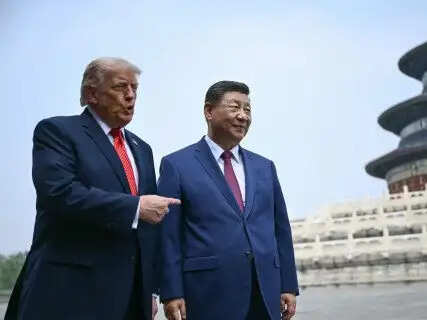
A massive diplomatic ripple has swept across the globe following US President Donald Trump’s return from his historic state visit to China. Marking the first time in nearly a decade that a sitting American president has traveled to the Chinese mainland, the highly anticipated summit with President Xi Jinping was expected to focus primarily on trade pacts. However, the post-visit remarks made by the US President have sent shockwaves through geopolitical circles, raising serious questions about whether Washington is shifting its long-standing strategic stance on the sensitive Taiwan issue in exchange for mega trade deliverables.The escalating unease stems from Trump’s blunt assessment of the military reality between Beijing and Taipei. Instead of reinforcing absolute security guarantees, the American commander-in-chief suggested a more transactional and cautious approach, creating a state of high anxiety within Taiwan's leadership, which had only recently cooperated with Washington on massive semiconductor supply chain investments.The Tyranny of Distance: Why Trump Views Taiwan as a Logistical NightmareIn a candid post-summit interview, President Trump openly analyzed the severe geographical disadvantages the United States faces if it ever attempts a direct military intervention against a Chinese offensive. Pointing directly to the sheer disparity in size and proximity, Trump noted that the odds heavily favor Beijing due to its massive geopolitical footprint right next to the disputed island ecosystem."When you look at the odds, China is a very powerful, big country. That’s a very small island," Trump noted during his briefing. Elaborating on the logistical difficulties, he highlighted that Taiwan sits barely 59 miles away from mainland China, while the United States is located a staggering 9,500 miles away across the Pacific Ocean. Describing it as a highly complex problem, Trump’s statements heavily hint that the US may no longer be willing to engage in a high-cost, distant kinetic conflict on behalf of Taipei.Accusations of Chip Theft and Criticisms of Past US AdministrationsAdding fuel to the fire, the US President took a sharp jab at previous American administrations for allowing global supply chains to move entirely out of the United States. He explicitly accused Taiwan of taking away America’s manufacturing dominance in the critical semiconductor sector, a business ecosystem that now powers everything from advanced consumer smartphones to defense-grade artificial intelligence systems."If you look at the history, Taiwan was developed because we had presidents that didn’t know what they were doing. They stole our chip industry," Trump asserted. Political analysts observe a clear pattern here: while Washington successfully pushed Taiwan to relocate over $250 billion worth of advanced semiconductor manufacturing facilities to American soil, it appears increasingly hesitant to provide unconditional military backing in return. Trump went as far as advising Taipei to "stay quiet" and maintain the existing status quo rather than provoking the political leadership in Beijing.Disagreements Over Defense Accords and Growing Unease in TaipeiThe sudden shift in tone has triggered immediate alarm bells within Taiwan’s Ministry of Foreign Affairs. Previously, the US government maintained that it would never consult Beijing regarding arms sales to the democratic island, which was highlighted by a recently approved $11 billion defense package. However, Trump indicated that future military supply agreements would undergo fresh evaluations, indicating that arms deals could become leverage in his ongoing negotiations with Xi Jinping.In response to the shifting rhetoric from Washington, Taiwanese diplomats have publically reminded the United States that arms sales are not mere business transactions, but form the very bedrock of regional peace and stability in the Indo-Pacific. With Trump touting massive bilateral business deals with Beijingincluding multi-billion dollar commitments for Boeing aircraft and American agricultural exports the international community is left wondering if the safety of Taiwan has become a bargaining chip in the ultimate great-power competition.
Around the web