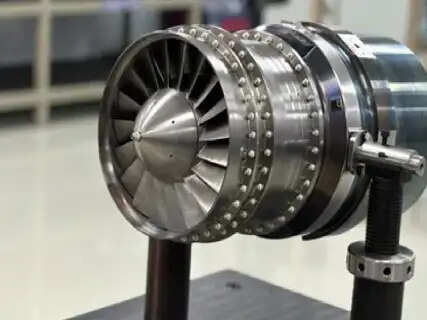
Marking a monumental breakthrough in India's aerospace and defense manufacturing sector, the Defence Research and Development Organisation (DRDO) and private sector partner Azad Engineering have successfully delivered the country's first production unit of a 350 kg thrust-class expendable turbojet engine to the Gas Turbine Research Establishment (GTRE). This achievement thrusts India into an exclusive, elite global club of nations capable of indigenously designing and manufacturing advanced combat-grade turbojet engines. Designed to power next-generation military hardware, this technological leap shatters decades of foreign import dependency and positions the nation firmly on the path toward complete self-reliance under the Atmanirbhar Bharat Abhiyan.Powering Cruise Missiles and High-Speed Kamikaze DronesEngineered primarily for single-use military operations, this compact powerhouse will serve as the engine for critical tactical assets including long-range cruise missiles, jet-powered loitering munitions, and high-speed target drones. While traditional propeller-driven drones typically cruise at speeds under 200 kmph, platforms integrated with this high-velocity jet engine can achieve speeds exceeding 400 to 450 kmph, drastically compressing enemy reaction windows. Developing compact turbojet technology is widely regarded as one of the toughest engineering challenges globally, demanding specialized expertise in aerodynamics, high-temperature metallurgy, precision combustion physics, and turbine engineering.Strategic Advantages and the Path to Fighter Engine MasteryUnlike conventional fighter jet engines built to endure thousands of flight hours, expendable turbojets are optimized for single-mission efficiency, prioritizing high reliability, compact sizing, and low mass production costs over long operational lifespans. According to defense and technology experts, the mastery of this compact technology provides the foundational knowledge base and testing experience required for compressor, turbine, and combustion systems. This vital engineering data will eventually accelerate India's ambition to develop heavy-duty, high-thrust fighter engines exceeding 100 kN, effectively sealing foreign vulnerabilities and ensuring unhindered production for future strategic warfare platforms.
Around the web