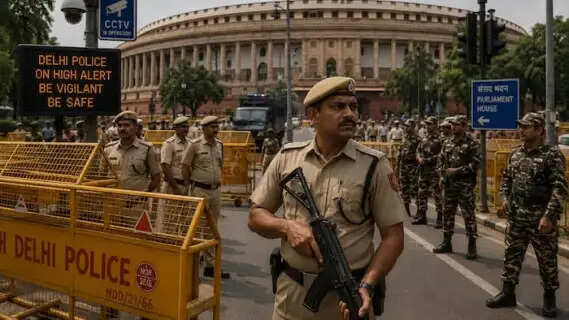
Security across New Delhi has been scaled up to maximum vigilance ahead of the Monsoon Session of Parliament and a proposed 'Chalo Sansad' protest march organised by the Cockroach Janta Party (CJP). To maintain public order and prevent potential disruptions, the Delhi Police has strictly enforced prohibitory orders under Section 163 of the Bharatiya Nagarik Suraksha Sanhita (BNSS), replacing the erstwhile Section 144 CrPC across the New Delhi administrative district. The heightened security measures come amid mobilisation over alleged examination paper leaks, with protesters demanding educational reforms and political accountability.Zero Tolerance for Unauthorised ProcessionsIn an official public advisory issued on social media platform X, Deputy Commissioner of Police (New Delhi) Sachin Sharma clarified that no administrative permission had been sought by or granted to the organisers for any procession or march toward Parliament. Authorities emphasised that any gathering outside designated zones will be treated as unlawful.Strict Prohibition Scope: All public meetings, assemblies of five or more persons, processions, demonstrations, slogan-shouting, and picketing are prohibited within the Sub-Division Parliament Street.Designated Site Exception: The restrictions apply throughout the entire subdivision, explicitly excluding the designated protest area at Jantar Mantar Road, provided that prior written clearance is obtained.Legal Consequences: Officials warned that individuals violating the prohibitory orders will face immediate prosecution under Section 223 of the Bharatiya Nyaya Sanhita (BNS).Multi-Tiered Security Grid and Ground DeploymentTo prevent unauthorised movement into high-security zones, the police administration has divided New Delhi into 15 distinct security zones, each supervised directly by Special Commissioners, Joint Commissioners, and Deputy Commissioners of Police. Over 5,000 security personnel, bolstered by 25 battalions of the Central Armed Police Forces (CAPF), including specialised women's units, have been deployed at key arterial intersections.Critical government infrastructure—including Vijay Chowk, Rashtrapati Bhavan, the Prime Minister's Residence, the Home Minister's Residence, India Gate, and Parliament Street—has been designated as strict no-protest zones.Surveillance, Transport Monitoring, and Emergency ReadinessSecurity forces have placed Jantar Mantar under a robust three-tier security ring consisting of multi-layer barricading, anti-sabotage squads, and round-the-clock CCTV surveillance. Armed quick-response teams, water cannons, and riot-control vehicles remain stationed at strategic transit nodes, including Connaught Place, Central Vista, and Shankar Chowk.At the same time, security teams are closely monitoring entry gates at New Delhi Metro stations, and authorities can close specific station gates on short notice if passenger flow compromises security protocols. Nearby government hospitals have also been placed on elevated alert status, while intensive vehicle checks are being conducted at all border entry points into the capital.
Around the web