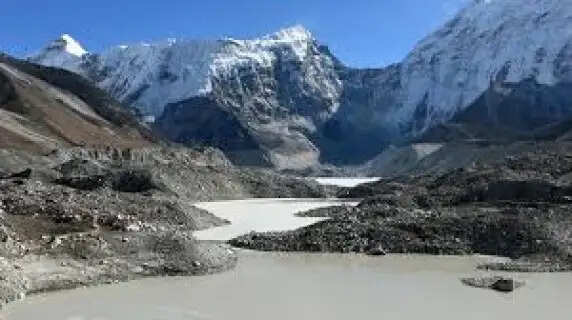
For decades, the world believed that rising atmospheric temperatures were the sole enemy of the Himalayas. However, a groundbreaking new study has sent shockwaves through the scientific community by identifying a "hidden" threat: Geothermal Heat.Research from the Wadia Institute of Himalayan Geology suggests that the "Third Pole" is being attacked from both sides—scorching solar heat from above and intense crustal heat from below accelerating ice loss at an unprecedented rate.The Invisible Enemy: How Geothermal Heat WorksWhile global warming melts the surface, geothermal energy (heat originating from the Earth’s interior) is targeting the base of these frozen giants. Due to the intense tectonic activity beneath the Himalayan range, the Earth's crust in certain regions is significantly warmer.This underground heat causes "basal melting," creating a thin layer of water between the glacier and the rock. This acts as a lubricant, making the glaciers unstable and causing them to slide down slopes much faster than expected.The "Snow Drought" Crisis of 2026The timing of this study coincides with a severe "Snow Drought" observed across the Hindu Kush Himalayas in early 2026. Experts from ICIMOD (International Centre for Integrated Mountain Development) have noted that weakened western disturbances have led to the driest spring seasons in centuries.Without the natural "buffer" of fresh snow to reflect sunlight, the glaciers are exposed to even more heat, creating a vicious cycle of rapid depletion.Immediate Dangers: Flash Floods and "Hanging Glaciers"The dual-threat of heat has increased the frequency of Glacial Lake Outburst Floods (GLOFs). As glaciers melt internally, they form hidden sub-glacial lakes that can burst without warning.Hanging Glaciers: A recent alert has been sounded for over 850 "hanging glaciers" across the 2,500km Himalayan range. These steep, unstable ice masses pose a direct threat to millions of people living in downhill hamlets in Uttarakhand and Himachal Pradesh.River Volatility: Basal melting is causing river levels—such as the Parvachik in Ladakh—to hit record highs during unexpected seasons, leading to winter flash floods followed by bone-dry summers.The Downstream Impact: A Threat to 2 Billion PeopleThe Himalayas serve as the "Water Towers of Asia," feeding ten major river systems including the Indus, Ganga, and Brahmaputra. If the current rate of melting continues, the hydrological cycle of the entire South Asian subcontinent could collapse.Short-term: Increased flooding and landslides.Long-term: Catastrophic water shortages for agriculture and hydropower, affecting nearly 20% of the global population.The Scientific Verdict: A Call for Sub-Surface MonitoringScientists are calling for a paradigm shift in how we monitor the Himalayas. Satellites can see the shrinking surface, but "blind spots" exist regarding what is happening underneath. Enhanced geothermal monitoring and "cryosphere change impact assessments" are now urgent requirements to prepare for the volatile future of the region.
Around the web