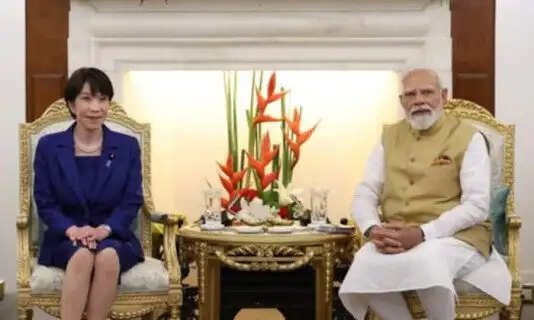
Amid shifting global alliances and mounting trade uncertainties, India and Japan have significantly escalated their strategic defence alignment. During the 16th India-Japan Annual Summit held at New Delhi's Hyderabad House, Prime Minister Narendra Modi and his newly elected Japanese counterpart, Sanae Takaichi, issued a comprehensive Joint Statement expressing deep and serious concern over the deteriorating security situation in both the East and South China Seas. Firmly pushing back against Beijing's expanding footprint, both leaders explicitly opposed any coercive or unilateral actions that threaten freedom of navigation, jeopardise overflight rules, or seek to alter the maritime status quo by force arbitrarily.Defending UNCLOS and Opposing Militarisation of Disputed WatersThe joint statement directly targeted the deployment of heavy infrastructure across contested maritime zones. PM Modi and PM Takaichi shared critical concerns over the rapid militarisation of disputed geographic features in the Indo-Pacific. They strongly reaffirmed that all regional maritime disputes must be resolved entirely through peaceful diplomatic means, completely free from coercion, and strictly in accordance with international law, as reflected under the United Nations Convention on the Law of the Sea (UNCLOS).Beyond the territorial waters, the bilateral talks targeted North Korea’s provocative ballistic missile and nuclear weapon programs. Acknowledging the dangerous proliferation of missile technology running both to and from Pyongyang, the leaders demanded total compliance from all UN Member States regarding UNSC sanctions. They called for an absolute ban on North Korean arms transfers and insisted on an immediate resolution to the historical abduction issue.Addressing the Myanmar Crisis and Demanding Safe Transit via the Strait of HormuzThe geographic scope of the Modi-Takaichi summit extended deeply into Southeast Asia and the Middle East, reflecting the broad reach of the India-Japan Special Strategic and Global Partnership. Both Prime Ministers expressed deep worry regarding the prolonged internal conflict in Myanmar and its cascading security impact on neighbouring borders. They renewed their international call for a complete cessation of hostilities. They urged the creation of a neutral environment to foster an inclusive, Myanmar-led dialogue aimed at achieving durable peace.Turning their attention to global energy security, the leaders addressed the tense situation surrounding Iran. They emphasised the absolute necessity of securing completely free, safe, and unhindered navigation through the critical Strait of Hormuz. With both New Delhi and Tokyo facing volatile global energy logistics, both democracies are prioritising resilient supply chains for crude oil, natural gas, and essential manufacturing goods, operating within international law.
Around the web