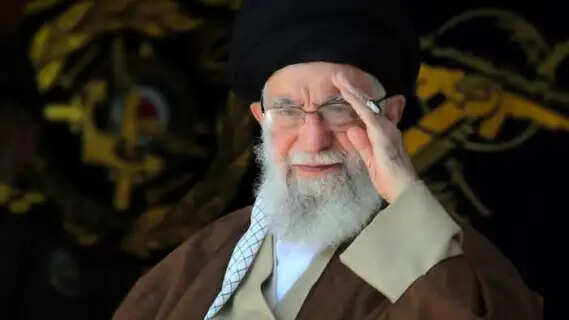
Iran has officially laid to rest its long-serving Supreme Leader, Grand Ayatollah Seyyed Ali Hosseini Khamenei, in the early hours of Friday, July 10, 2026. The historic burial took place exactly 131 days after he was assassinated in a high-intensity, joint US-Israeli airstrike on February 28—a catastrophic opening salvo that plunged West Asia into an all-out regional war.Khamenei was interred within the Dar al-Zikr section of the holy Imam Reza Shrine in his birthplace of Mashhad. The announcement was formalised through his official social media account, closing an unprecedented six-day multi-city funeral procession that drew millions across Iran and neighbouring Iraq.Millions Choke Mashhad Streets, Forcing Casket Transport via HelicopterThe final chapter of the state funeral brought the northeastern holy city of Mashhad to a complete standstill. An ocean of devotion-driven mourners dressed in black flooded the avenues, waving crimson flags—symbolising the Shia Islamic call to avenge the blood of martyrs—and carrying massive banners demanding retribution against Western leadership.The density of the crowds completely paralysed local transit, moving the vehicle carrying the casket mere inches at a time over several hours. Due to the impenetrable sea of people packing the main thoroughfares, organising committees were forced to deploy a military helicopter to airlift Khamenei's flag-covered coffin directly over the crowds into the blue-tiled precincts of the shrine.A Historic Distinction: Fulfilling his explicit final wishes penned in his will, Khamenei has become only the second Iranian ruler in modern history to be interred at the Imam Reza Shrine. The first was Nader Shah, who was buried at the holy site following his assassination in 1747.New Successor Stays Hidden as US-Iran Airstrikes Explode AgainInternational intelligence networks closely monitored the meticulously staged final rites for an appearance by the new Supreme Leader, Mojtaba Khamenei. However, the newly incumbent leader remained entirely out of public view, continuing a total public absence maintained since his swift appointment days after his father's death.While state TV footage showed senior dignitaries weeping over the coffin—including Parliament Speaker Mohammad Bagher Ghalibaf and Chief Justice Gholamhossein Mohseni Ejei—the funeral prayers were led exclusively by the late leader's eldest son, Mostafa Khamenei. Diplomatic sources suggest that Mojtaba’s absolute absence is dictated by extreme security risks and unconfirmed reports that he may have sustained severe injuries during the initial February 28 strikes.The massive security concerns were starkly underscored by a dramatic breakdown of the recently negotiated humanitarian truce. Even as the burial proceeded late into the night under the shadow of a single fighter jet escorting the late leader's transport plane, active hostilities erupted across the Gulf:US Incursions reported: Iranian state media reported fresh American airstrikes targeting key communication nodes and logistics lines, including a strategic railway track running between Tehran and Mashhad.Asymmetric Retaliation: The Islamic Revolutionary Guard Corps (IRGC) retaliated immediately, launching extensive drone and missile packages targeting US Patriot defence batteries and military installations anchored across Kuwait, Bahrain, and Qatar, alongside interceptions reported over Jordan.While US defence officials stated that the incoming strikes caused no casualties or significant structural damage, the immediate reignition of warfare guarantees that the passing of Iran's "Identity Keeper" marks the beginning of an incredibly volatile, unpredictable chapter for the Middle East.
Around the web