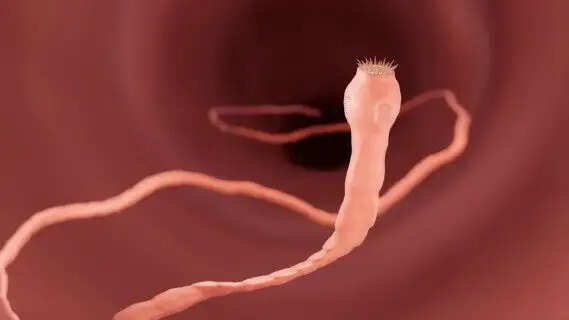
What began as an exciting two-month travel adventure across India in 2007 slowly mutated into a harrowing, decade-long health emergency for a resident of Carmarthenshire, Wales. Lowri Denman, 42, recently shared her extraordinary health journey after battling a severe and rare parasitic brain infection that completely derailed her thirties. Despite intentionally adhering to a strict vegetarian diet throughout her travels to avoid standard food-borne illnesses, an unnoticeable microscopic exposure left an invasive parasitic colony quietly nesting inside her central nervous system for years without presenting a single initial symptom.The Shocking Discovery: A Meter-Long Intestinal Tapeworm Passes in a RestroomThe first physical indication of a severe parasitic infestation occurred out of the blue in 2010—three years after Denman had returned to the UK. While using the bathroom at a local restaurant, she was horrified to pass an intact adult tapeworm measuring over a meter in length, which she described as having a ribbed texture resembling industrial packing tape.Although she immediately sought medical assistance, her initial stool tests came back completely satisfactory and normal. Believing the worst was behind her, she returned to her everyday life. However, within a year, the infection advanced aggressively. Denman began experiencing debilitating, unprecedented headaches, followed by a terrifying episode where she suddenly lost the ability to articulate words. Moments later, she suffered her first major grand mal seizure, losing consciousness entirely and waking up inside an emergency ambulance with no memory of the event.Inside the Scans: Uncovering 38 Parasitic Cysts Lodged in Brain TissueFollowing a series of urgent CT and MRI scans at the hospital, medical specialists delivered a staggering diagnosis that left Denman and her family completely shell-shocked. Radiologists identified exactly 38 distinct parasitic cysts lodged deep within her brain tissue.While clinicians initially suspected common feline-borne toxoplasmosis, tracking her medical history back to the meter-long tapeworm confirmed a definitive diagnosis of neurocysticercosis. According to the World Health Organisation (WHO), while eating undercooked larval pork can result in an adult tapeworm in the human gut, neurocysticercosis occurs through a different pathway. It is contracted by accidentally ingesting microscopic tapeworm eggs shed in the faeces of an infected human carrier—typically via contaminated water, unwashed raw vegetables, or poor hand hygiene in food-preparation areas. Once swallowed, these microscopic eggs hatch into larvae, penetrate the intestinal wall, migrate through the bloodstream, and form fluid-filled lesions within the brain.A Decade of Relapses, Severe Psychosis, and Final CalcificationThe road to recovery turned into a complex, multi-year medical battle. While initial rounds of anti-parasitic medications like albendazole and praziquantel combined with heavy steroids successfully shrank the initial swelling, weaning off the medication caused the inflammation to aggressively flare up in different parts of her brain. The persistent brain swelling triggered severe neurological and psychiatric damage. Denman began suffering from deep cognitive confusion, bodily numbness, intense panic attacks, and acute paranoia that deteriorated into full-blown psychosis. Her condition worsened to the point where she was admitted to a neuropsychiatric ward for a six-week institutional stay, during which she experienced severe regression and erratic behaviour.To break the relentless cycle of recurring brain inflammation, specialists eventually placed her on methotrexate—a powerful immunosuppressant drug typically utilised in chemotherapy regimens. Over the years of managed treatment, the 38 parasites finally died off completely and calcified into harmless, hard nodules inside her skull, eliminating the need for invasive neurosurgery. Denman has remained completely seizure-free since 2017, and though she must stay on anti-epilepsy medication for the rest of her life, she has successfully returned to her career. Her infectious disease consultant, Dr Brendan Healy, described her as a truly remarkable "once-in-a-career" patient, prompting Denman to launch a public crowdfunding initiative to produce a detailed podcast series to educate international travellers on food hygiene and the critical neurological warning signs of larval infections.
Around the web