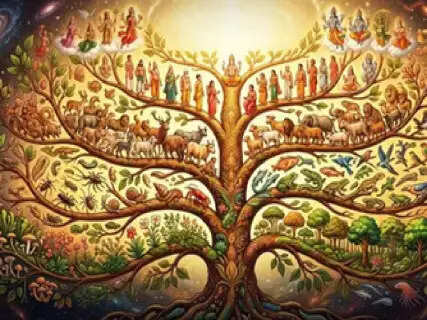
One of the most famous and profound concepts in Vedic philosophy is that a soul must cycle through 8.4 million births (84 Lakh Yonis) before finally earning a human form. While modern science continuously updates its catalog of planetary biodiversity, ancient Hindu scriptures like the Padma Purana and Garuda Purana mapped out the exact mathematical categories of global life forms thousands of years ago. Classified under complex metaphysical laws, this structural taxonomy explains the evolutionary journey of consciousness and highlights why human birth is considered the ultimate gateway to spiritual liberation.The Scriptural Breakdown: Deciphering the 8.4 Million Mathematical FormulaThe definitive mathematical classification of planetary life is explicitly stated in Chapter 78 of the Padma Purana. The text features a precise Sanskrit verse that breaks down the biodiversity into distinct biological and environmental counts:$$Jalaja\ Nav\ Lakshani,\ Sthavara\ Laksha-Vinshati,\ Krimayo\ Rudra-Sankhyah,\ Pakshinam\ Dash-Lakshanam.\ Trisha-Lakshani\ Pashavah,\ Chatur-Lakshani\ Manavah.$$When decoded into modern mathematics, this ancient taxomony aggregates to the precise figure of 8.4 million life forms:Aquatic Creatures (Jalaja): 900,000 (9 Lakh) species thriving in water bodies.Immobile Life Forms (Sthavara): 2,000,000 (20 Lakh) species of plants, trees, and vegetation.Insects and Reptiles (Krimayo): 1,100,000 (11 Lakh) species of crawling creatures and microbes.Aves and Birds (Pakshinam): 1,000,000 (10 Lakh) species flying in the skies.Terrestrial Animals (Pashavah): 3,000,000 (30 Lakh) species of four-legged land beasts.Human Beings (Manavah): 400,000 (4 Lakh) variations of human and advanced consciousness.The Scientific Classification of Ancient Rishis: Yonij versus AyonijLong before modern evolutionary biology categorized organisms by cellular structures, ancient Indian sages classified all living beings into two fundamental structural origins based on their birth mechanism. The first category is Yonij, which encompasses complex multicellular organisms born out of the physical union of two parents. The second is Ayonij, which defines micro-organisms, asexual life forms, and elemental single-celled entities (similar to amoebas) that spontaneously evolve or replicate on their own from environmental factors. Furthermore, these organisms are geographically mapped into three environmental layers: Aquatic (water-dwellers), Terrestrial (land-dwellers), and Nabhachar (sky-dwellers).The Transmigration Timeline: The Soul’s Metaphysical Cycle in the Garuda PuranaAccording to the karmic doctrines detailed in the Garuda Purana, the migration of the soul through these millions of biological vessels is not random; it is strictly governed by the accumulated energy of past actions (Karma). The scripture describes a transformative cycle where a soul may spend up to 3 million lifetimes as various plant forms, followed by hundreds of thousands of cycles as insects, birds, and advanced mammals. The spiritual lineage states that the soul eventually climbs the evolutionary ladder to take the sacred form of a cow. From this point of high spiritual purity, the soul transitions into the human realm, experiencing up to 400,000 variations of human life to fully exhaust its worldly desires.The Ultimate Gateway: Why Human Life is the Only Axis for SalvationIn Hindu philosophy, the human body is celebrated as Manusha Tanu Durlabham—an exceptionally rare, highly sophisticated vehicle that stands separate from all other biological life forms. While animals, plants, and lower organisms live purely in a state of consumption, experiencing the direct reactions of past karma without the ability to alter their destiny, the human form possesses the unique gift of Viveka (intellectual discernment). This capacity to distinguish between right and wrong allows humans to consciously perform virtuous deeds, practice devotion, serve society, and actively break free from the infinite loop of rebirth to achieve Moksha (ultimate salvation).
Around the web