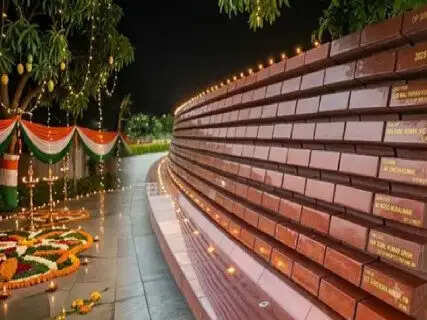
Suspense Crime, Digital Desk : For the first time, the Indian government has officially announced the names of six brave soldiers who made the supreme sacrifice in Operation Sindoor to defend the nation. These soldiers include five from the Indian Army and one from the Air Force. Their names have been added to the Roll of Honor on the National War Memorial website.Soon, the names of these indomitable soldiers will be engraved in golden letters on the granite walls of the Tyag Chakra memorial in Delhi. Let's learn about the valor of these brave sons and what this Tyag Chakra, where their names will be immortalized forever, is about.What is the cycle of sacrificeThe National War Memorial, located in the India Gate complex in the capital, Delhi, is divided into four concentric circles. One of the most prominent circles is the Tyag Chakra, dedicated to the brave soldiers who sacrificed their lives in defense of the motherland.The design of the Tyag Chakra is inspired by the famous Chakravyuha from the Mahabharata. The idea is to depict the indomitable courage and combat skills of soldiers, which teaches them to remain steadfast in the field even in adverse conditions.This circle consists of 16 circular walls made of granite stones. These walls bear the names of over 25,000 soldiers martyred in major post-independence wars, such as the 1962 India-China War, the 1965, 1971, and 1999 India-Pakistan wars, and other military operations. Now, the names of these six martyrs of Operation Sindoor are about to be added to this glorious list.6 immortal martyrs of Operation SindoorLance Naik Dinesh Kumar (5 Field Regiment): Dinesh Kumar, along with four other comrades, held the front line under heavy Pakistani fire. He was martyred while repelling the enemy.Aviator Mood Muralinayak (851 Light Regiment): Muralinayak, a native of Andhra Pradesh, was on a crucial mission to intercept infiltrators along the Line of Control. Displaying indomitable courage, he was seriously injured and breathed his last on 9 May.Sergeant Surendra Kumar (Indian Air Force): Surendra, a native of Rajasthan, was a medical assistant. During the Pakistani attacks, he risked his life to provide medical assistance to the wounded in the RS Pura sector and was martyred on May 10.Subedar Pawan Kumar (10 Infantry Brigade): Pawan Kumar, a native of Himachal Pradesh, had just two months left for retirement. While on duty in Rajouri, he was injured while bravely facing Pakistani fire and sacrificed his life for the nation on May 10th.Rifleman Sunil Kumar (Jammu): Sunil Kumar held his ground in the bunker until his last breath. When the enemy came very close to the post, he fearlessly emerged and defended his post, attaining martyrdom on May 10.Havildar Sunil Kumar Singh (Bihar): Sunil Kumar Singh was closely monitoring Pakistani drone activity. Despite being seriously injured in the attack, he did not abandon his post and fought valiantly, attaining martyrdom on June 6.The other three circles of the National War Memorial1. Amar Chakra: This is the innermost core of the memorial. A massive 15.2-meter-high granite obelisk stands here, beneath which the "Amar Jawan Jyoti" burns 24 hours a day. This never-extinguishing flame symbolizes the immortal souls of the martyrs and their eternal sacrifice.2. Vir Chakra: Designed as a covered gallery, this wall is engraved with bronze sculptures that bring to life scenes from six of the most historic battles fought by the Indian Army, Navy, and Air Force. It fills every Indian with pride.3. Protector Circle: This is the outermost circle of the memorial, formed by a dense row of over 600 trees. The trees that surround the memorial symbolize the soldiers who are also deployed day and night on the borders, protecting Mother India.
Around the web