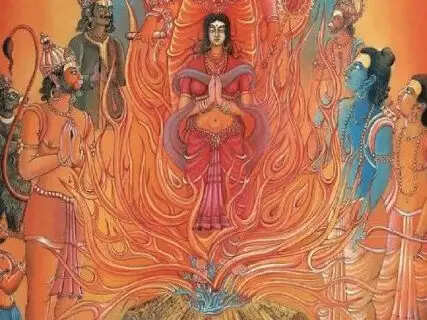
For generations, the timeless epic of the Ramayana has cemented Mother Sita in the cultural consciousness of millions as the ultimate epitome of grace, patience, sacrifice, unwavering devotion, and quiet resilience. In standard adaptations and traditional retellings—most notably the epic authored by Sage Valmiki—Sita is portrayed as the gentle daughter of Mother Earth, standing beside Lord Rama through exile and trial with profound emotional strength rather than physical combat.However, recent cinematic depictions and classical scriptural revelations have brought a startlingly different dimension of her character into the spotlight. Did the goddess of compassion ever step onto the battlefield? Did she take up divine arms to vanquish evil? While the Valmiki Ramayana makes no mention of Sita wielding weapons, another sacred text—the Adbhut Ramayana—presents a breathtakingly powerful, fierce avatar of Mother Sita as the supreme primordial energy (Adishakti), stepping forward to save the universe when even Lord Rama faced defeat.The Untold Tale: Entering the Realm of the Adbhut RamayanaTo understand this fierce portrayal, one must look beyond the standard epic into the Adbhut Ramayana, a specialized text that explores deeper esoteric layers, divine leelas, and alternate narrative episodes connected to the Ramayana cosmos.According to this text, the narrative unfolds after Lord Rama successfully defeated the ten-headed demon king Ravana in Lanka and returned to Ayodhya to establish his righteous rule. During a royal assembly, the revered sage Agastya arrived in Ayodhya and was welcomed with utmost respect by Lord Rama, who declared that the world was finally freed from demonic terror.To everyone's surprise, Maharishi Agastya responded with grave solemnity. He revealed to Rama that the ten-headed Ravana he had vanquished was merely a minor adversary compared to a far greater cosmic menace still at large.Sahasra Ravana: The Thousand-Headed Demon KingSage Agastya recounted the existence of Sahasra Ravana (Ravana with a thousand heads), a far more formidable demon residing on Pushkar Island across the southern ocean. Possessing a thousand heads and two thousand arms, Sahasra Ravana dwarfed the ten-headed Ravana in both raw physical power and dark magical prowess.The sage declared that Lord Rama's victory over evil would remain fundamentally incomplete as long as Sahasra Ravana lived. Recognizing his duty to protect the realms, Lord Rama gathered his faithful commanders—including Hanuman, Sugriva, Vibhishana—and mobilized the vanara army to march toward Pushkar Island.Upon reaching the island, a fierce battle commenced. Confident in his divine weaponry, Lord Rama drew his mighty bow and released the infallible Brahmastra toward Sahasra Ravana. To the utter shock of the entire army, the thousand-headed demon casually opened one of his mouths and swallowed the celestial weapon whole.When Mother Sita Assumed the Fierce Form of MahakaliEmpowered and enraged, Sahasra Ravana counterattacked with devastating force, overpowering the monkey army and eventually rendering Lord Rama unconscious on the battlefield. Panic rippled through the ranks as the demon advanced to deliver a final, fatal blow to Lord Rama.Witnessing her lord and husband fallen, Mother Sita underwent a transcendent transformation. Stepping forward to protect cosmic order, she assumed the terrifying, awe-inspiring form of Mahakali—the fierce, unyielding embodiment of time, destruction, and supreme female energy.The Adbhut Ramayana describes this cosmic metamorphosis in vivid detail. Sita's stature grew to towering proportions, her arms multiplied to wield a vast array of divine weapons, her eyes burned red with righteous fury, and her divine radiance blinded the battlefield.The Defeat of Sahasra Ravana and the Triumph of AdishaktiFaced with the terrifying fury of Mahakali, Sahasra Ravana was gripped by mortal terror. Before he could recalibrate his dark powers, Mother Sita engaged the demon in ferocious combat. With unmatched swiftness and precision, she began severing his thousand heads one by one until none remained.In a powerful symbolic gesture echoing traditional iconography, she fashioned a garland from the severed heads of the defeated demon and wore it around her neck, restoring balance to creation and reviving Lord Rama.While traditional retellings emphasize Sita's earthly grace and endurance, the Adbhut Ramayana immortalizes her as the ultimate source of all power—reminding devotees that the gentle protector of hearth and home is also, when righteousness demands, the fierce destroyer of cosmic evil.
