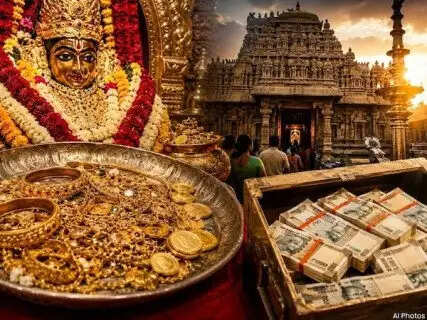
Most of us have grown up associating temple prasad with laddus, mishri, or maybe a piece of fruit if you're lucky. The idea of walking out of a temple with currency notes in your hand or gold jewellery being returned to you as a divine blessing sounds like something from a folk tale.But these two temples in India are very real — and what happens inside them is unlike anything you'll find anywhere else in the country.Sri Varamatharum Maligaiparai Karupasamy Temple, Tamil NaduTucked away in the hills of Theni district in Tamil Nadu, this temple doesn't look like it would stand out from a distance. But for the people who know about it — and many travel from far away to reach it — this is the place you come to when everything else has failed.The presiding deity here is Karupasamy, widely revered as the god of justice. The temple's full name itself carries the answer many devotees are seeking: "Varamatharum" translates to "giver of boons." People bring their unresolved legal disputes, family conflicts, and long-standing hardships to this temple, hoping for divine intervention when human options have run out.The Offering That Left the Internet SpeechlessA video that recently went viral on social media captured something that genuinely surprised people who had never heard of this temple before. Here, instead of devotees leaving donations behind, the temple gives currency notes back to the people who come seeking blessings.You read that right. Cash is distributed as prasad.In most temples across the country, money flows from the devotee to the deity. Here, it flows the other way. It's a tradition that carries deep symbolic meaning — the idea that the deity, recognising the struggles of those who come with genuine faith, blesses them not just spiritually but in a tangible, practical way.When to VisitIf you're planning a visit, Thursdays, Fridays, and new moon days are considered the most auspicious. Special pujas and arulvakku — a form of divine prophecy — are conducted on these days. Priest A.P.S. Shivakumar Poosari carries forward this tradition with devotion, keeping the ancient practice alive.Mahalaxmi Temple, Ratlam, Madhya PradeshFor most of the year, the Mahalaxmi Temple at Manak Chowk in Ratlam, Madhya Pradesh, sits quietly in the heart of the city — visited by regular devotees, observed by passing locals, unremarkable to outsiders.Then Diwali arrives. And everything changes.A Decoration Worth Over ₹100 CroreIn the five days surrounding Diwali — beginning with Dhanteras — this temple undergoes a transformation that has to be seen to be believed. Devotees bring their most precious possessions to offer to Goddess Mahalakshmi: currency notes, gold jewellery, diamond necklaces. The temple is literally decorated with these offerings, layering wealth upon wealth until the entire space shimmers under the light.Estimates suggest the total value of decorations during this period exceeds ₹100 crore. That figure is staggering for a temple in a mid-sized Madhya Pradesh city, and it speaks volumes about the faith that draws people here year after year.The Part That Makes It Truly SpecialWhat sets this temple apart isn't just the scale of the offerings — it's what happens after the festivities conclude. The silver coins and jewellery offered by devotees are not absorbed by the temple. They are returned to the devotees as prasad.Families take these items home and place them in their safes, their lockers, their most treasured corners of the house — believing that whatever has touched the feet of Mahalakshmi carries her blessing into their lives throughout the year ahead.A Tradition Older Than Living MemoryThis practice is said to have been started by Maharaja Ratan Singh Rathore, and it has continued without interruption ever since. The tradition has survived generations, political changes, and the shifting currents of modern life — because the faith behind it has never wavered.Two Temples, One IdeaWhat connects these two temples, separated by hundreds of kilometres and rooted in entirely different regional traditions, is a shared belief that true devotion creates abundance — and that abundance, when it comes from the divine, should flow back to the faithful.In a country filled with remarkable places of worship, these two stand in a category entirely their own.
Around the web