
Umar Khalid, Sharjeel Imam Bail Pleas in Supreme Court Today
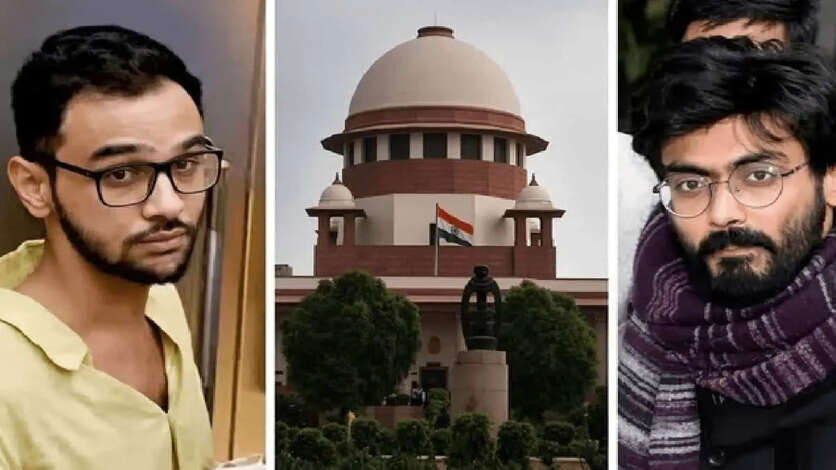
In a closely watched legal development carrying major constitutional and personal-liberty implications, the Supreme Court of India is scheduled to hear fresh bail petitions filed by former Jawaharlal Nehru University (JNU) scholars Umar Khalid and Sharjeel Imam on Wednesday, November 25, 2026, in connection with the 2020 North-East Delhi riots "larger conspiracy" case registered under the stringent Unlawful Activities (Prevention) Act (UAPA). Listed before a three-judge bench headed by Chief Justice of India (CJI) Surya Kant alongside Justices Joymalya Bagchi and V. Mohana, the separate Special Leave Petitions—registered as SLP (Crl.) No. 22342/2026 for Umar Khalid (filed through advocate N. Sai Vinod) and SLP (Crl.) No. 22241/2026 for Sharjeel Imam (filed through advocate Fauzia Shakil)—challenge a September 30, 2026 judgment of the Delhi High Court that upheld a trial court's July 4 order declining them regular bail. Having spent more than six years in judicial custody without trial reaching completion, both petitioners have urged the apex court to grant relief on the ground that the prosecution has still failed to complete the examination of protected witnesses, even as the one-year timeframe set by the Supreme Court in its January 5, 2026 order approaches expiry. For legal scholars, civil-rights observers, law students, and citizens tracking landmark UAPA jurisprudence across northern India—including readers in Lucknow and neighboring Uttar Pradesh cities such as Unnao, Kanpur, Prayagraj, and Varanasi, where Supreme Court rulings on prolonged pre-trial detention and personal liberty draw widespread public and academic attention—today's hearing could shape the trajectory of the long-running prosecution.
Key Legal Grounds Raised by Umar Khalid and Sharjeel Imam Before the Apex Court
At the heart of today's proceedings is the interplay between prolonged pre-trial incarceration, slow trial progression, and the explicit liberty window granted by the Supreme Court earlier this year:
| Case Parameter | Verified Legal Record & Petition Submissions |
| Supreme Court Bench & Date | CJI Surya Kant, Justice Joymalya Bagchi, and Justice V. Mohana — listed for hearing on Wednesday, November 25, 2026. |
| Petition Numbers & Counsel | Umar Khalid: SLP (Crl.) No. 22342/2026 (Advocate N. Sai Vinod) Sharjeel Imam: SLP (Crl.) No. 22241/2026 (Advocate Fauzia Shakil) |
| Lower Court Orders Challenged | Challenges the Delhi High Court's September 30, 2026 common judgment, which declined to interfere with the trial court's July 4, 2026 rejection of regular bail. |
| January 5, 2026 Supreme Court Condition | While denying bail on January 5, 2026, an earlier bench permitted Khalid and Imam to renew their bail pleas either upon completion of the examination of protected witnesses or upon the expiry of one year, whichever occurred earlier. |
| Trial & Witness Scale Cited | Charge sheet filed on September 25, 2020 against 18 accused; prosecution has cited more than 900 witnesses, including 47 protected witnesses, whose examination remains incomplete despite over six years of custody. |
Why the Delhi High Court Declined Relief—and What Sets Today's Hearing Apart
When Umar Khalid and Sharjeel Imam approached the trial court in July and subsequently the Delhi High Court in September 2026, the High Court observed that it lacked jurisdiction to modify or relax the specific conditions laid down in the Supreme Court's January 5, 2026 order, while also noting that earlier judicial orders had distinguished their alleged roles as "ideological drivers" from other co-accused. Notably, in January 2026, the apex court had granted bail to five co-accused—Gulfisha Fatima, Meeran Haider, Shifa-ur-Rehman, Mohd. Saleem Khan, and Shadab Ahmed—and later extended six months' interim bail to Tasleem Ahmed and Khalid Saifi.
Before the CJI-led bench today, both petitioners contend that keeping them incarcerated indefinitely when the prosecution has not finished examining its 47 protected witnesses—and with the one-year benchmark stipulated in January 2026 nearly elapsed—violates the constitutional right to a speedy trial under Article 21. How the three-judge bench interprets the pace of protected-witness testimony and the approaching one-year threshold will determine whether Khalid and Imam finally secure bail or face an extended legal wait.